McFarlane et al. (2007) acknowledges the critical nature of cultivating culturally safe spaces in schools if we want to ensure all learners achieve their potential. When it comes to dialogic discussions, Alexander (2020) insists that getting the class climate right is critical for this approach to thrive. Oldehaver (2018) emphasises that if genuine reciprocity is to be a feature of the dialogic discussions, a culturally safe environment is fundamental. Developing the capacity to collaborate begins with establishing a set of joint ground rules. This is essential if discussion groups are to function effectively; where all participants have equal status (Sams & Dawes, 2004). Researchers speak about how the establishment of discussion norms or ground rules should be a collaborative event (Alexander, 2020, Davies & Meissel, 2015, Oldehaver, 2018, Wilkinson et al. 2010).
In the research project, the creation of safe spaces, by co-constructing the Game Rules, built trust amongst the students in their group which, in turn, built confidence. From this emerged discussion spaces where students knew no one would talk over them, where there were no arguments and only one person talked at a time. Students grew in confidence when speaking in front of others because active listening showed they valued what was being shared. Given an opportunity to lead a discussion made one student feel “like they had a superpower”.
We’re more likely to follow them
They make you feel comfortable
You know you won’t be judged
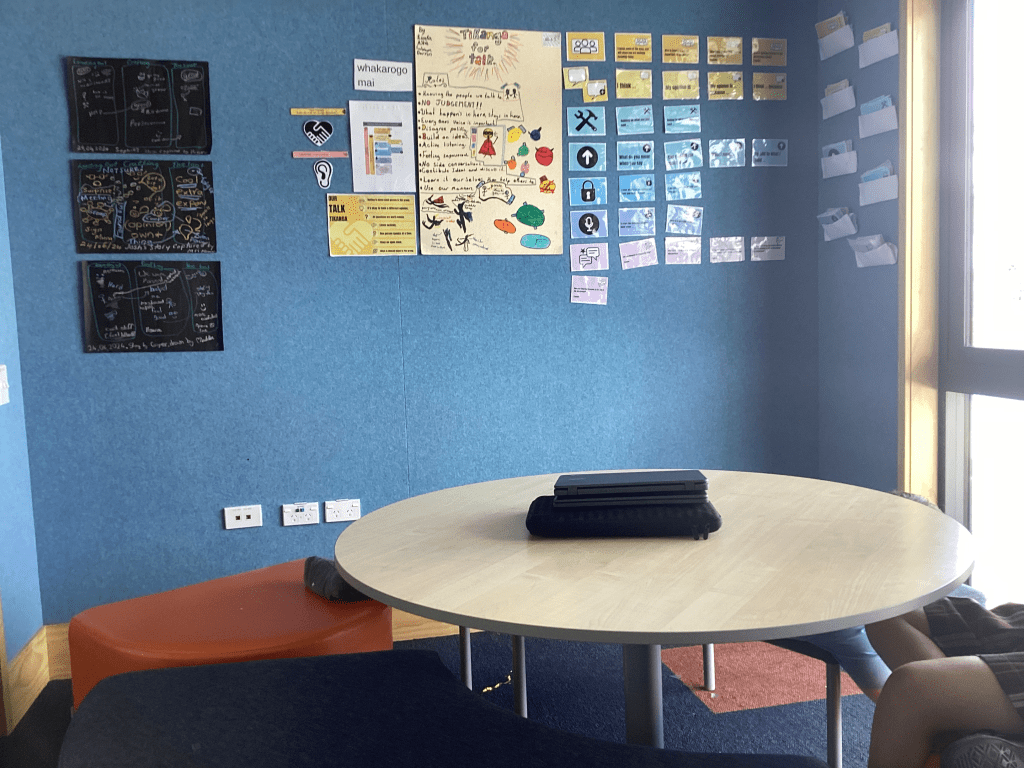
An interesting point to note is one research group affirming, not only were safe spaces created through the co-construction of Game Rules and building of relationships, but the space in its physical sense had impact. Students pointed out the allocation of a dedicated space for dialogic discussions showed them the pedagogy was important and prioritised. Having ownership of the space also implied the value placed on the space as a whole; being student-owned.
Alexander, R. (2020). A dialogic teaching companion. Routledge.
Davies, M., & Meissel, K. (2016). The use of Quality Talk to increase critical analytical speaking and writing of students in three secondary schools. British Educational Research Journal, 42(2), 342-365.
Macfarlane, Angus & Glynn, Ted & Cavanagh, Tom & Bateman, Sonja. (2007). Creating Culturally-Safe Schools for Māori Students. The Australian Journal of Indigenous Education. 36. 10.1017/S1326011100004439.
Oldehaver, J.L. (2018). Developing a ‘culturally validated’ dialogic indicator tool: A reconceptualised analytical framework using talanoa to code classroom talk. Waikato Journal of Education. 23(1), 15- 41. doi: 10.15663/wje.v23il.617https://files.eric.ed.gov/fulltext/EJ1233136.pdf
Wilkinson, I. A. G., A. O. Soter, and P. K. Murphy. 2010. “Developing a Model of Quality Talk About Literary Text.” In Bringing Reading Research to Life, edited by M. G. McKeown and L. Kucan, 142–169. New York: Guildford Press.
 The dialogic highway
I would truly love any feedback or thoughts!